
How to Choose a Reliable T-shirt Manufacturer: The Professional’s Guide
Authored By
MagTexco Editorial Team
Choosing a T-shirt manufacturer looks simple until the first sample arrives, the first delivery slips, or the first bulk order reveals that “good quality” meant something very different to buyer and factory.
The strongest manufacturing relationships are built well before production starts. A good supplier gives clarity on fabric, fit, tolerances, testing, timelines, and communication. That clarity lowers risk, protects margins, and makes repeat orders far easier to manage.
For brands in Australia, Europe, the UK, or the US, the right partner is rarely the cheapest one on paper. It is the one that can deliver consistent, sellable product at the standard your market expects.
Product quality standards for a good T-shirt manufacturer
A good T-shirt manufacturer should be able to explain fibre composition, yarn quality, knit structure, fabric weight, shrinkage behaviour, and finishing treatments in plain commercial language. If a supplier cannot clearly discuss GSM, ring-spun versus open-end yarn, or how a silicone wash changes hand feel, that is usually an early warning sign.
Construction matters just as much. Neck rib recovery, shoulder reinforcement, stitching density, seam stability, hem consistency, and size tolerance all shape how a T-shirt performs after wear and washing. A premium look in photos means very little if collars twist, side seams torque, or lengths vary too much across the same size run.
Sampling is where quality promises become measurable. After reviewing initial information, buyers should expect a manufacturer to show discipline in areas like fabric specification accuracy, size set approval, wash and shrinkage testing, colour consistency, and final inspection.
Production systems and quality control
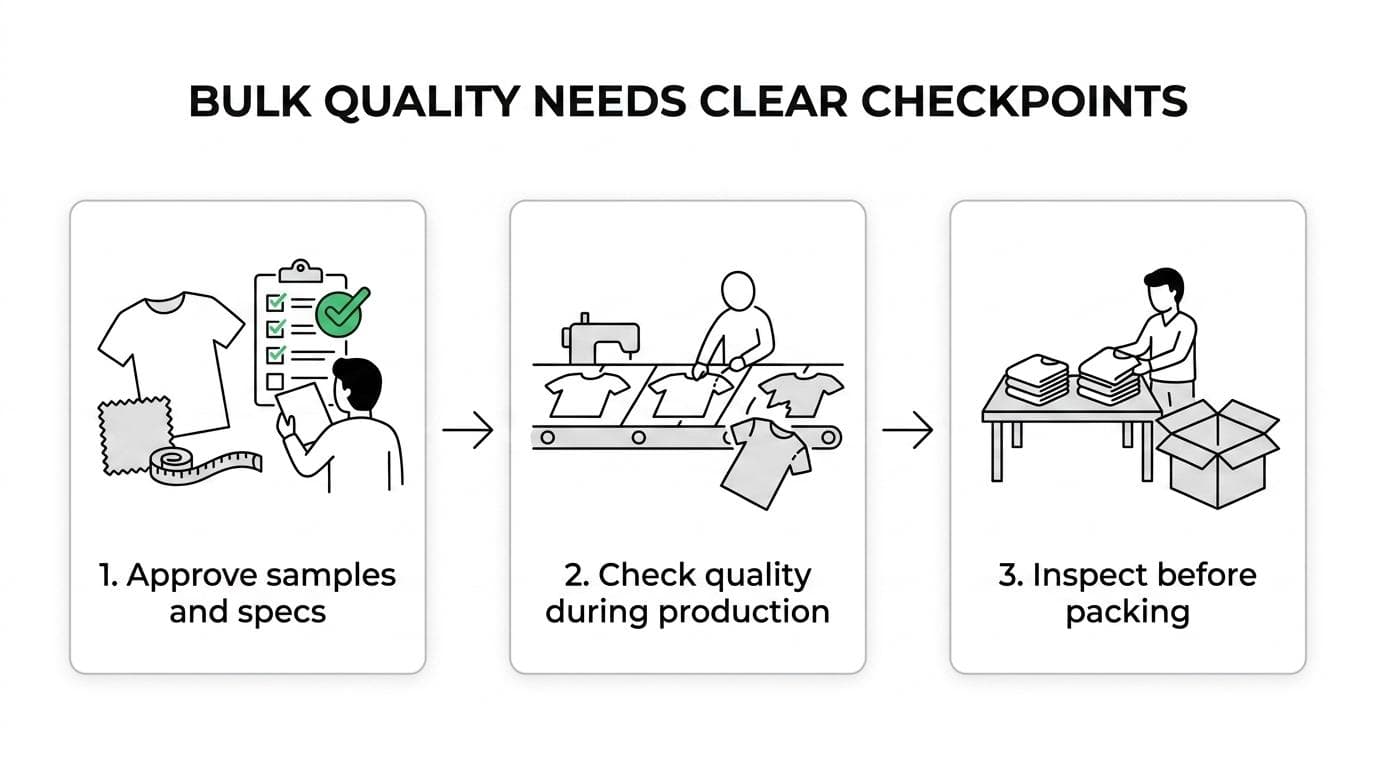
Reliable t-shirt production is built on systems. That includes pattern development, grading, marker planning, cutting control, sewing line balance, finishing, inspection, and packed-goods verification. A factory does not need to be fully automated to be highly effective, but it does need structure.
Manufacturing signals and buyer checks
One of the easiest ways to judge maturity is to ask how the factory moves from tech pack to bulk. Strong suppliers can explain each step without hesitation, including where buyer approval is needed and how deviations are handled.
Key signals include: Structured sampling process (reduces fit errors), In-line quality control (finds defects early), Final inspection protocol (protects shipment quality), and Documentation discipline (tracks specs and revisions).
Fabric sourcing transparency
fabric sourcing has a direct effect on margin, product positioning, and brand credibility. Whether it's cotton jersey, organic combed cotton, or recycled blends, a capable manufacturer should be able to guide that discussion with realistic trade-offs on price, performance, and availability.
Transparency is the real differentiator. Many suppliers can say a fabric is “premium” or “sustainable”, but fewer can identify the mill, confirm the fibre claim, and provide supporting paperwork.
Certifications and compliance
Certifications like ISO 9001, GOTS, and GRS can be useful signals, though they should never replace factory evaluation. A good T-shirt manufacturer should be able to show which certifications are held and what each one covers.
Lead times, MOQs and communication
A good manufacturer gives realistic lead times, not ideal-case promises. Communication is the thread that holds the whole process together. Clear replies, early issue reporting, and organised approval records can save weeks of delay.
Comparing local, nearshore and offshore
Location shapes more than freight cost; it affects speed to market and operational control. Local manufacturing offers oversight and speed for small runs, while offshore large-scale production offers scale economics for high-volume programs.
Ready to scale your T-shirt production? Contact our team for a professional consultation.
Contact UsExplore related services
Use these routes to move deeper into our Tunisian manufacturing content and product categories.